

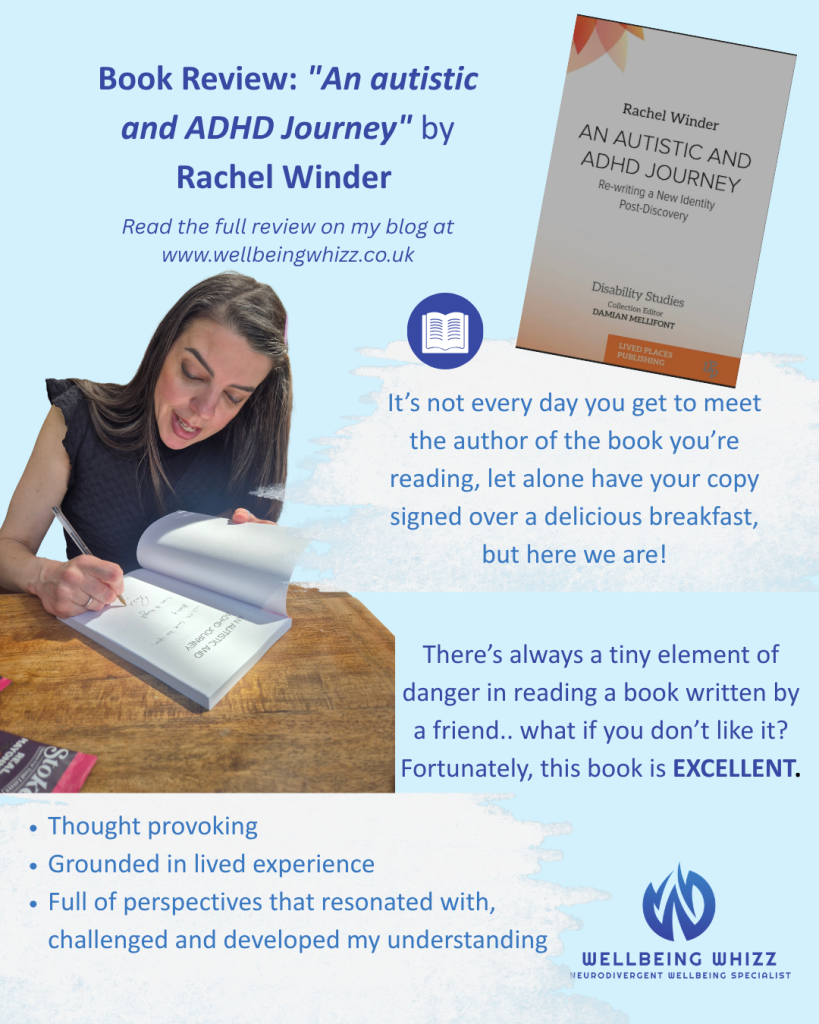
It’s not every day you get to meet the author of the book you’re reading — let alone have them sign your copy over a delicious breakfast! Although, in this case, Rachel Winder isn’t just an author I’ve met – she’s also a friend.
Although there’s something slightly nerve-wracking about reading a book written by someone you know; what if you don’t like it? What if it doesn’t resonate? What on earth do you say afterwards?!
Fortunately, I didn’t need to worry.
I’ve been making a conscious effort recently to spend more time reading, particularly books that allow me to learn from other people’s lived experiences. I genuinely believe that one of the best ways we can develop our understanding of neurodivergence is by listening to people who actually live it — and I say that as an autistic and ADHD person myself.
That’s also why I don’t only seek out perspectives that mirror my own.
No single autistic or ADHD person can represent an entire community, and it’s something I’m very mindful of saying before any training or talks I deliver. I find enormous value in recognising experiences that resonate with my own, but equally in encountering ideas that challenge how I’ve previously thought about something or give me a completely different way of understanding it.
An Autistic and ADHD Journey gave me plenty of both.
Lived experience alongside understanding
One of the things I particularly enjoyed about Rachel’s book was the way personal experience sits alongside explanations of autism and ADHD.
Rachel explores her experiences both before and after recognising her neurodivergence, and I found the contrast particularly interesting. Looking back at experiences with the knowledge we have now can completely change the meaning we give them.
There were also lots of smaller concepts throughout the book that made me stop, think, scribble notes and occasionally disappear down my own research rabbit holes!
I particularly enjoyed exploring ideas around sensory processing, stimming, executive functioning, monotropic attention and intersectionality.
Rachel’s discussion of sensory experience also introduced me to terminology and sensory systems I hadn’t previously explored in as much depth, including things such as nociception, chronoception, equilibrioception and thermoception.
That’s one of the things I want from a book like this: not simply to finish it thinking “yes, I already knew all of that”, but to come away with new questions and things I want to explore further.
Different experiences can develop our understanding
There were things that strongly resonated with my own experience and other things that didn’t — and that’s important.
Autistic and ADHD people aren’t a homogeneous group.
Our strengths, difficulties, environments, identities, experiences and support needs are different. Reading lived-experience accounts allows us to build a much richer picture of neurodivergence than we ever could by relying on a single person’s experience.
Rachel also describes neurodivergent strengths, including things such as pattern recognition, systems thinking, tenacity and a strong sense of justice. I appreciated the balance of recognising genuine difficulties and support needs without presenting neurodivergence solely through a deficit-based lens.
Another part I found particularly interesting was Rachel’s discussion of parenting and the importance of considering the needs underlying behaviour rather than simply responding to the behaviour itself. Again, that’s an idea that extends far beyond parenting.
Whether I’m delivering training or supporting somebody individually, I frequently come back to the importance of asking why.
Why is this environment difficult?
Why is this demand creating a barrier?
Why does this particular strategy or adjustment help?
Understanding the why gives us far more useful information than simply trying to change what we can see on the surface.
What will I take from it?
Some of the ideas in this book will undoubtedly find their way into my own work.
Not because one person’s lived experience should be treated as evidence of what all autistic or ADHD people experience, but because different perspectives help us ask better questions.
I’ve already found myself thinking about how some of the concepts Rachel discusses could complement areas I explore within autism education, coaching and training.
And perhaps that’s my biggest takeaway from An Autistic and ADHD Journey.
Lived experience isn’t valuable because one person can tell us what autism or ADHD is like. It’s valuable because every additional perspective helps us understand just how varied those experiences can be.
I thoroughly enjoyed reading Rachel’s perspective, learning some new things along the way, and finding ideas that resonated with, challenged and developed my own understanding.
And fortunately, I can now tell my friend that I genuinely thought her book was excellent.
Which saves us from having a very awkward breakfast next time. 😂