Abby Booth

The Discomfort of Being Vulnerable – and Why I do it Anyway

I’m going to admit something about the realities of delivering autism training as an autistic trainer. Every time I stand in front of a room or online meeting and talk about autistic meltdowns, a small part of me feels uncomfortable. Not because I don’t understand them professionally, but because I’m talking about myself. It’s one […]

The Discomfort of Being Vulnerable – and Why I do it Anyway Read More »

When Something Unexpected Happens: From “What If?” to “What Next?”

A client asked me a question recently that, on reflection, is something I hear surprisingly often: “How do I prepare for something when I don’t even know what’s going to happen?” At first, I smiled because it felt like such an honest question, but it quickly made me realise how many different versions of it

When Something Unexpected Happens: From “What If?” to “What Next?” Read More »

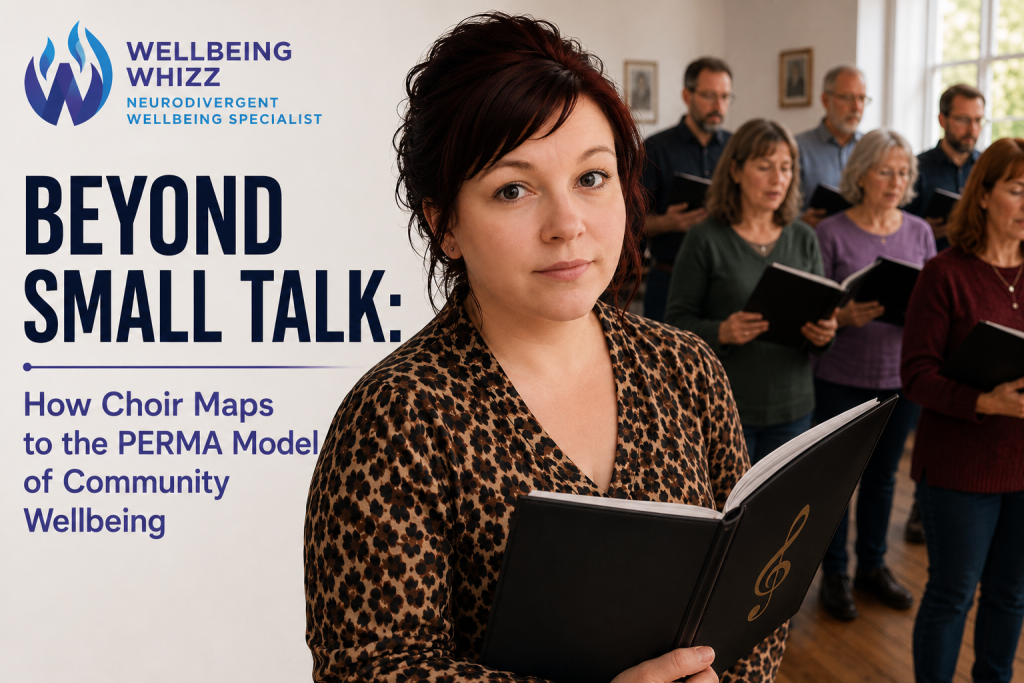
Beyond Small Talk: How Choir Maps to the PERMA Model of Community Wellbeing

  When people talk about creating a sense of belonging or building community, the conversation almost always focuses on traditional socialising. We assume that connection is a verbal endeavour—built on making small talk, mingling in busy rooms, and sustaining continuous conversations. For many autistic people, ADHDers, or anyone navigating a high cognitive load, that traditional

Beyond Small Talk: How Choir Maps to the PERMA Model of Community Wellbeing Read More »

Transitions Are Work Too: Why Going Back Can Feel So Hard

This week, my children and I have been navigating a transition. For them, it was returning to school after half term and for me, it was returning to work after a week of annual leave. These are of course different situations, but a surprisingly similar challenge! As autistic and ADHD people, we often talk about

Transitions Are Work Too: Why Going Back Can Feel So Hard Read More »

How do you remember to use coping strategies when you need them?!

I teach regulation strategies as part of my role — and I still forget to use them.  Today I was delivering a training session around regulation, mindset, and rejection sensitive dysphoria (RSD). As part of the session, we talked about strategies that can help in the moment when emotions feel overwhelming. One of the participants

How do you remember to use coping strategies when you need them?! Read More »

✨ Three Years In: What Running Wellbeing Whizz Has Taught Me (As an Autistic Professional)

Ironically, I am posting this on 1st May, however this is a blog about April. April always feels like a reflective month for me. It’s my birthday month, it’s Autism Acceptance Month – and this year, it also marks three years of Wellbeing Whizz. When I first started, I don’t think I fully realised where

✨ Three Years In: What Running Wellbeing Whizz Has Taught Me (As an Autistic Professional) Read More »

Diagnosis Is Not an Endpoint – It Is a Starting Point.

Diagnosis Is Not an Endpoint. It Is a Starting Point. Understanding Identity After Autism Diagnosis In my experience – both personally and professionally – when autistic adults receive a diagnosis, people often assume clarity arrives overnight. In reality, it rarely feels that simple. Nothing about your personality has changed. Your history is the same. Your

Diagnosis Is Not an Endpoint – It Is a Starting Point. Read More »

Why Your Strategy Isn’t Working (And It’s Not Because You Aren’t Trying)

Ah, task and time management. If you’re neurodivergent, you’ve probably done everything “right.” You’ve bought the planners (shout out to my fellow planner addicts who just can’t resist!). Downloaded the apps. Learned the systems. You’ve tried the Pomodoro technique, time-blocking, and every “anchor” habit in the book. And yet, you still feel like you’re failing.

Why Your Strategy Isn’t Working (And It’s Not Because You Aren’t Trying) Read More »

The Elephant in the Room: Pricing, Growth, and Valuing Neurodivergent Work Why pricing feels uncomfortable (especially in caring professions)

When I first started thinking seriously about pricing my work, imposter syndrome showed up almost immediately. At the beginning, I felt like an “unknown”. Even though I knew my skills, experience, and depth, there was a persistent question in the background: why would someone choose to pay for my services if they don’t know me

The Elephant in the Room: Pricing, Growth, and Valuing Neurodivergent Work Why pricing feels uncomfortable (especially in caring professions) Read More »

Scroll to Top