

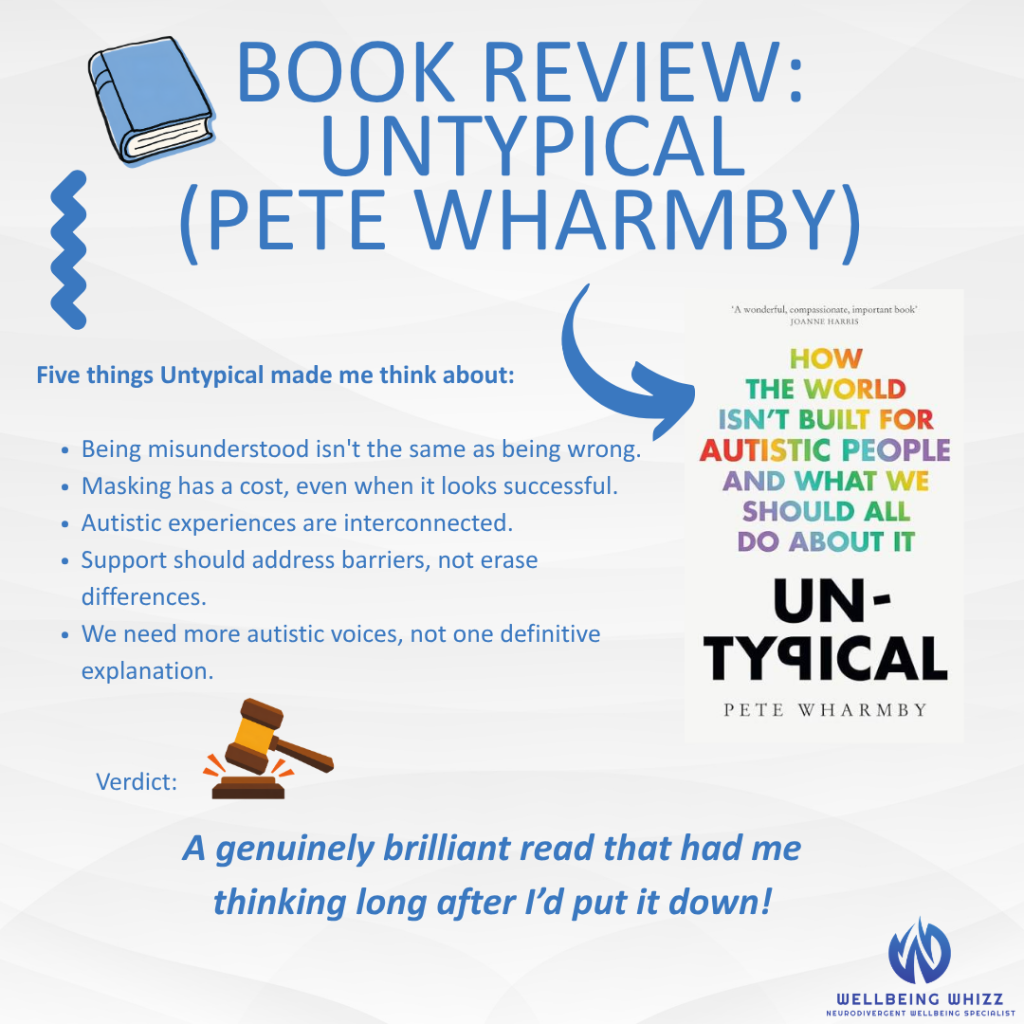
Some books teach you something new. Others make you question what you thought you already understood. For me, Untypical managed to do both.
I’ve recently finished reading Untypical: How the World Isn’t Built for Autistic People and What We Should All Do About It by Pete Wharmby, and I can genuinely say it was one of the most thought-provoking books about autism I’ve read. In fact I liked it so much I contacted Pete directly via his website to tell him!
As an autistic and ADHD wellbeing practitioner, understanding neurodivergence is central to both my personal experiences and my professional work. I spend a lot of time supporting neurodivergent people to understand themselves, recognise their needs and develop strategies that work for them; but something that’s incredibly important to me is continuing to develop my own understanding.
Having lived experience doesn’t mean I understand every autistic experience. And having professional knowledge doesn’t mean I’ve finished learning.In fact, one of the things I enjoy most is coming across an idea that makes me stop reading, put the book down and think:Hang on. I’ve never considered it like that before. Well, there were plenty of those moments throughout Untypical.
Looking beyond autistic behaviours
One of the strongest themes I took from Pete’s writing was the importance of understanding autistic experiences rather than simply observing autistic behaviours.
This felt significant because so much of the language historically used to describe autism focuses on what other people can see. Someone avoids eye contact. Someone struggles with unexpected changes. Someone appears blunt. Someone becomes overwhelmed in a busy environment. The problem is, describing a behaviour doesn’t necessarily explain what’s happening for the person experiencing it.
Take eye contact, for example.
An autistic person might find eye contact uncomfortable, distracting or overwhelming. Yet someone else might interpret their lack of eye contact as disinterest or rudeness. The difficulty isn’t necessarily the autistic person’s behaviour. It may be the assumptions being made about that behaviour, and this is something I encounter regularly in my work.
When we’re supporting autistic people, I think it’s essential to ask not just what is happening? but why might this be happening, and what is the person experiencing? Taking the time to understand the experience behind a behaviour can completely change how we respond to it.
Masking, expectations and the cost of fitting in
Another area that particularly resonated with me was Pete’s exploration of masking.
Masking is often described as hiding autistic characteristics to fit in with other people’s expectations. What I find particularly interesting is that masking isn’t always a conscious choice; it can develop through years of learning what other people expect, recognising when our natural responses are considered unacceptable and adapting to avoid negative reactions.
Over time, those adaptations can become automatic.
This made me think about the relationship between masking, social expectations and our sense of safety. If someone has repeatedly experienced criticism, rejection or misunderstanding, changing their behaviour may become a way of protecting themselves. Although masking might help someone navigate certain situations, that doesn’t mean it comes without a cost – it can require significant cognitive and emotional effort.
Someone might appear to be coping perfectly well while internally managing sensory discomfort, monitoring their communication and suppressing their natural responses.
Appearing comfortable isn’t the same as being comfortable.
I think that’s something we need to remember when considering autistic people’s support needs.
Communication differences aren’t communication failures
I also found Pete’s discussion of communication particularly interesting.
Autistic communication is often described in terms of difficulties or deficits. However, communication involves at least two people, and misunderstandings can happen because people have different expectations about how information should be expressed or interpreted.
One point that particularly stood out to me was the difference between understanding something immediately and understanding it after having time to process. For example, an autistic person might not recognise the implied meaning behind someone’s comment during a conversation. Later, when they’ve had time to reflect, they might understand exactly what the person meant. This doesn’t necessarily mean they lack the ability to understand social meaning, it may mean that accessing that understanding in real time requires more processing than the situation allows and that distinction matters.
Rather than assuming someone needs to become better at interpreting communication, we might also consider how communication environments could become more accessible. Could we allow additional processing time? Be more explicit? Reduce reliance on implied meaning?
Sometimes, the most effective adjustment isn’t changing how an autistic person communicates. It’s changing how we communicate with them.
The connections between autistic experiences
This was probably my biggest area of reflection throughout the book.
We often discuss different aspects of autism separately; sensory processing. Communication. Executive functioning. Emotional regulation. Routines. Masking. Breaking these concepts down can be useful, particularly when we’re trying to understand them individually.
However in everyday life, they don’t operate independently of one another.
Imagine an autistic person in a busy, noisy environment. The sensory demands might already be taking up a significant amount of their processing capacity. Someone then asks them an unexpected question. They may find it difficult to process the question, organise their thoughts and respond immediately. If they’re also trying to maintain eye contact, monitor their facial expressions or avoid appearing rude, that’s even more information and behaviour to manage.
If they struggle to recognise the early signs of overwhelm, they might not realise how much capacity they’ve used until they reach a point where everything feels too much. What might appear to be a communication difficulty could actually involve sensory processing, executive functioning, masking and emotional awareness interacting with one another. This is something I’ve become increasingly interested in exploring through my own work.
What happens when we stop looking at autistic characteristics as separate difficulties and start considering how they interact to shape someone’s experience of the world?
I think that question has enormous potential for developing more individualised, meaningful support, and it’s certainly something I intend to explore further.
Routines, predictability and understanding their purpose
Another theme that stayed with me was the importance of routines and predictability.
Autistic routines are sometimes described as rigid or inflexible, but that description doesn’t tell us why they matter.
Routines can reduce uncertainty, make daily life more predictable and decrease the number of decisions someone needs to make. For a person who already experiences significant processing demands, that predictability can be incredibly valuable. Unexpected changes might require additional cognitive effort, particularly when someone has already mentally prepared for a particular situation or outcome.
Sometimes it’s not simply the change itself that’s difficult, but the additional demands created by having to adjust expectations, process new information and work out what happens next. So rather than automatically encouraging autistic people to become more flexible, perhaps we should first understand what their routines provide and what support might make unexpected changes more manageable. Again, it comes back to understanding the purpose behind the behaviour.
No single autistic experience represents everyone
One of the things I appreciated most about Untypical was Pete’s acknowledgement that his experiences are his own.
He doesn’t present himself as someone who can speak for every autistic person, and I think that’s incredibly important. Autism is a spectrum of different experiences, characteristics, strengths and support needs. Some autistic people communicate through speech, while others are non-speaking. Some need substantial support with everyday activities, while others have needs that may be less immediately visible. There are also differences shaped by gender, ethnicity, culture, socioeconomic circumstances and other aspects of identity.
Pete highlights the importance of listening to a wider range of autistic voices, particularly those whose experiences have historically been underrepresented. This really resonated with me; my own experiences of being autistic and having ADHD inform how I understand neurodivergence, but they don’t make my experiences universal. Similarly, the experiences of the people I support are individual to them.
I think one of the most important things we can do, both personally and professionally, is remain curious, listen to different perspectives, question our assumptions and recognise when our understanding might be incomplete.
Most importantly – be willing to change our thinking when we encounter new information.
My verdict:
A genuinely brilliant read that had me thinking long after I’d put it down!
I thoroughly enjoyed Untypical.
Pete’s writing is engaging, accessible and often humorous, while exploring some of the very real difficulties autistic people encounter in a world that frequently misunderstands them.
There were moments when I recognised my own experiences, moments when I encountered perspectives different from mine, and plenty of moments when I found myself making connections between ideas.
Would I recommend it? Absolutely.
Whether you’re autistic yourself, supporting an autistic person or simply interested in developing a deeper understanding of autism, I think there’s a great deal to take away from this book – not because it provides a definitive explanation of autism, but because it encourages us to look beyond assumptions, listen to different experiences and ask better questions.
That’s something I think we could all benefit from doing.