

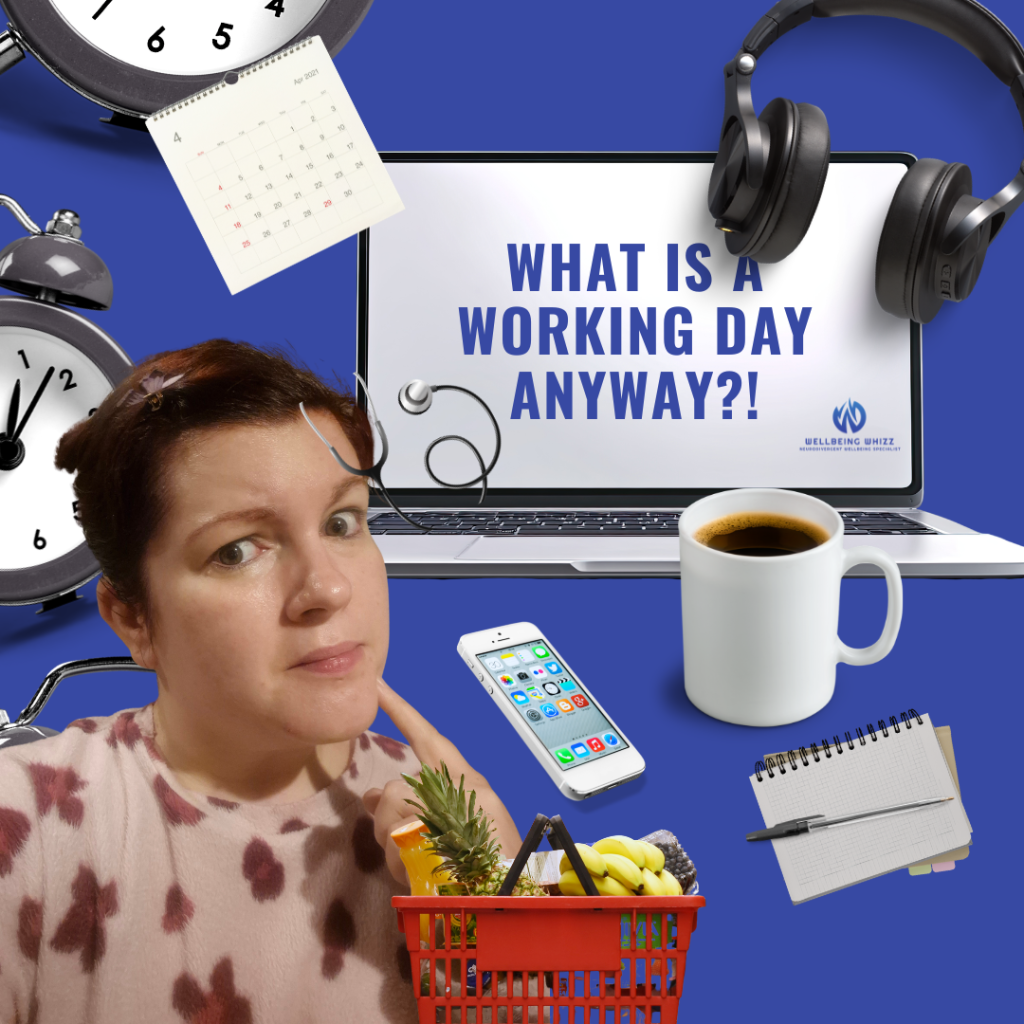
Working hours, flexible working, neurodivergence and the difference between having time and having capacity.
I’ve been thinking recently about what actually counts as a working day, which sounds like a fairly straightforward question, doesn’t it?
You start work, you do your work, you finish work. That’s your working day.
Except, increasingly, I’ve realised that my working days don’t necessarily look anything like that, and actually – I’m not entirely sure they need to.
When a working day doesn’t look like a working day
One of the things I love about being self-employed is having some flexibility over how I organise my time. I might start my morning answering emails, preparing for a coaching session or developing a resource. Then I might need to take one of my children to a medical appointment, pop to the shops or deal with something at home. Later in the afternoon, I might return to my laptop and finish what I was doing. Or perhaps I’ll have an idea for something creative at 10pm, and there I’ll be, curled up in my pyjamas, happily working away on my laptop.
This pattern raises an interesting question; if I’ve worked for six hours, but those six hours have been spread across twelve hours, have I had a six-hour working day or a twelve-hour working day? What about everything I’ve done in between?
Taking a child to an appointment, doing the shopping or managing family responsibilities might not count as paid work, but that doesn’t necessarily mean I’ve been resting. Those things require time, attention and energy too.
I think we sometimes overlook that distinction when we talk about work-life balance. Life outside work isn’t always leisure, and time away from paid work isn’t automatically time spent recovering. Having the time doesn’t mean having the capacity. This is probably the part I’ve been thinking about most.
We often talk about time management as though having enough time available is the main thing that determines whether we can complete a task. Having time available doesn’t necessarily mean having the capacity to use it in the way we’d planned. I think this is particularly relevant when we’re considering neurodivergence.
Different activities place different demands on us.
Something might require a lot of concentration, decision-making, social interaction, emotional processing or sensory tolerance, demands that don’t necessarily affect everyone in the same way.
For example, I might have an hour available to write a report, but find that I simply don’t have the mental capacity for that particular task at that moment. However, I might be perfectly capable of spending that hour designing a resource, organising a spreadsheet or developing an idea. It’s not necessarily that I can’t work, it’s that the type of work I have capacity for can change throughout the day and I think that’s an important distinction.
Sometimes, difficulty starting or completing a task can be interpreted as a problem with motivation, discipline or time management. But what if the issue isn’t how much time we have? What if it’s about the resources that particular task requires, and whether those resources are available to us at that moment?
Of course, this isn’t exclusive to neurodivergent people. Everybody experiences fluctuations in energy, attention and capacity. For autistic people and people with ADHD, factors such as executive functioning, sensory processing, emotional regulation and transitions between activities can add further complexity. Importantly, these things don’t operate independently of one another. For example a difficult conversation might affect my ability to concentrate afterwards. A busy sensory environment might leave me with less capacity for social interaction. An unexpected change might require additional processing before I can move on to something else.
So looking at a calendar and seeing an empty hour doesn’t necessarily tell us very much about what someone can realistically manage during that hour. Sometimes doing absolutely nothing is exactly what I need and I had a particularly good example of this recently. I was working through some tasks and started feeling a bit… meh.
Not particularly overwhelmed or especially stressed; just not really feeling it. Now I could have pushed through. There were things I wanted to get done, and technically, I had the time available. Instead, I decided to stop. For the next hour – I did absolutely nothing! Not a productive break, or a quick opportunity to get some household jobs done. Not even an activity I’d specifically chosen to help me relax.
I just stopped.
Do you know what? Afterwards, I felt much better.
I went back to my work and happily cracked on with the things I’d been struggling to engage with earlier. Now, I’m not suggesting that taking an hour off will magically resolve every difficulty with concentration, motivation or executive functioning, it won’t. But it was a useful reminder that sometimes the most helpful thing I can do isn’t to find another way to keep working. It’s to recognise when I need to stop. Perhaps, rather than viewing that hour as time I’d lost, I could recognise it as something that helped me continue with my day in a way that worked better for me.
There’s a tendency to think about breaks in terms of productivity; we rest so we can work harder or take a break so we can get more done. Yes, rest can certainly support our ability to work, but I think we need to be careful about making productivity the only justification for it.
Sometimes we need rest simply because we need rest and I think that should be enough.
What are we actually measuring?
I wonder whether some of our traditional ideas about working hours encourage us to focus on the wrong things. We often measure work in terms of time;
How many hours have you worked?
What time did you start?
What time did you finish?
Were you at your desk?
Of course, there are situations where working hours matter enormously. Many jobs require particular staffing levels, availability or coordination between people. But where there is flexibility, perhaps it’s worth considering whether time spent working is always the most useful measure. If somebody completes their work effectively, meets their responsibilities and maintains appropriate communication, does it necessarily matter whether they worked continuously from nine until five?
If somebody is sitting at their desk for eight hours but struggling with concentration, overwhelm or exhaustion, is that necessarily a better outcome? I don’t think it’s quite as simple as saying we should measure outcomes instead of hours either, because focusing entirely on productivity can create its own problems!
Finding a working day that actually works
I don’t think I’ve arrived at a definitive answer to what counts as a working day, and perhaps that’s because there isn’t one. Some days, my work happens in fairly predictable blocks.
Other days, it’s scattered between appointments, family responsibilities and whatever else life decides to throw at me. Sometimes I’m incredibly focused and can spend hours developing something without really noticing the time, and sometimes I need to step away and do absolutely nothing.
Occasionally (OK, more often than I’d like to admit), my most productive creative moments happen while I’m sitting in my pyjamas late at night. What I’m learning is that I don’t necessarily need to judge those days against an imaginary version of what a working day is supposed to look like. Instead, I can consider whether the way I’m working is effective, manageable and sustainable for me – and that’s something I think we can apply much more widely when talking about neurodivergence, wellbeing and reasonable adjustments in the workplace.
Not everybody will have the same needs, not everybody will have the same flexibility, and not everybody will find the same working patterns helpful – but everybody deserves the opportunity to understand what supports their wellbeing and, wherever possible, have those needs considered.
So maybe the question isn’t what a working day is supposed to look like, but what we need from our working day to make it work for us.