
When people talk about creating a sense of belonging or building community, the conversation almost always focuses on traditional socialising. We assume that connection is a verbal endeavour—built on making small talk, mingling in busy rooms, and sustaining continuous conversations.
For many autistic people, ADHDers, or anyone navigating a high cognitive load, that traditional route carries a heavy energy cost. The constant pressure to read social cues, process what someone has just said, think of what to say next, and mask internal anxiety can make “community” feel utterly exhausting rather than supportive.
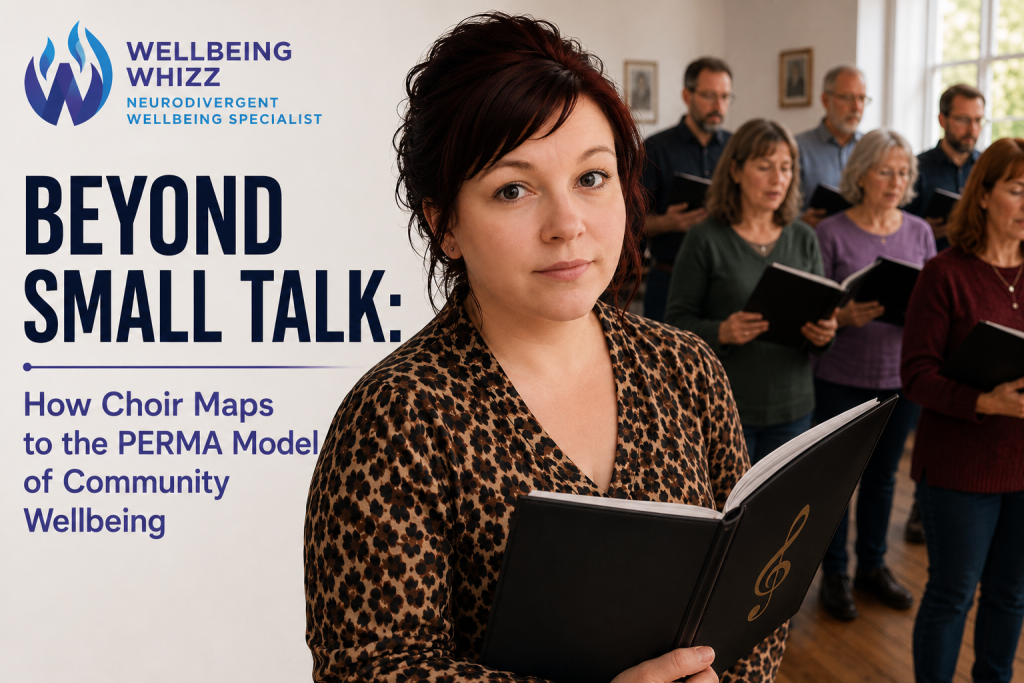
Ironically, it was another form of vocalising that showed me a different route to connection: joining a local community choir.
Standing in a room full of people singing quickly taught me that belonging doesn’t actually have to start with conversation. This is significant because when you’re there sitting in your section, the focus is entirely on the songs. Singing the same words and melodies with other people simultaneously, navigating the harmonies, and hearing the beautiful sound we are creating lets everyone share in a singular experience of connection.
Even if I don’t know what to say to people or how to introduce myself without feeling awkward, I feel a part of it:
- When there are new songs, we learn them together.
- When there are songs that are new to others, we help each other.
- When we are practicing familiar songs, we perform them together.
The Framework of Shared Purpose
As I stood in that room singing, I couldn’t help but notice how naturally the experience mapped onto the PERMA model of wellbeing – a framework I use regularly in my own work. PERMA (Seligman, 2011) is a framework we use in positive psychology that encompasses five core areas that, when combined, allow us to flourish. We can meet these areas in many different ways throughout our lives—it acts like a practical wellbeing guide, in a way.
While my professional work often looks at these letters individually, standing in a room full of people rehearsing made me realize that choir is a rare space where all five areas seamlessly align:
- P – Positive Emotion: The literal, physical lift and joy that comes from singing and locking into a beautiful harmony with others.
- E – Engagement: Being completely present and immersed in the music. When you are focusing on the notes, your brain finds that elusive “flow state” where the outside world goes quiet.
- R – Relationships (Connection): Feeling an alignment with the people in your section, the collective space, and the shared vulnerability of using your voices together.
- M – Meaning: Believing that the music matters and serving a purpose that goes beyond your own immediate, individual needs.
- A – Accomplishment: The quiet pride of finally mastering a tricky harmony, finishing a complex song, or simply showing up and singing a piece all the way through for the first time.
When we look at it through this lens, true connection in a community space isn’t just a random feeling ; it creates a natural, structured progression that leads straight to flourishing:
Choir provides a rare, beautiful pathway straight to Belonging because the environment is completely structured. You don’t have to earn your place socially. You belong the moment you walk through the door because you share a singular purpose. You look at the same sheet music, learn the same melodies, and make mistakes together. Your voice contributes to a collective sound that couldn’t exist without you.
For many neurodivergent people, the structure does the heavy social lifting. There is no need to manufacture conversation or decode unwritten rules in order to contribute. You simply turn up, rehearse, sing – and your voice becomes part of something bigger than yourself.
The Bit Nobody Talks About: The Tea Break
However, real life is rarely simple, and belonging doesn’t magically erase hidden social challenges. In any community group, there is usually a distinct line where structure ends and the unwritten rules of socialising begin.
For me, one of the hardest parts of choir isn’t learning the music or hitting the right notes. It’s the moment someone announces: “Right, let’s take a 15-minute tea break.”
Suddenly, the safe structure vanishes. The invisible social manual is thrown back at you, and the internal monologue starts spinning:
- Who am I supposed to sit or stand with?
- If I walk over to that group, am I interrupting?
- What do I do with my hands while I’m waiting?
- What if everyone else already has their designated person?
It is a striking contrast. In the span of two minutes, the exact same environment can shift from feeling deeply regulating and inclusive to intensely overwhelming.
Two Things Can Be True
Acknowledging the anxiety of the “unstructured tea break” is incredibly important. Too often, we assume that if we find a certain transition or social window difficult, it means the entire activity isn’t for us, or that we don’t truly “fit in.”
But two entirely opposite things can be true at the exact same time: An activity can be highly supportive, accessible, and regulating in one aspect, while being genuinely challenging in another. Finding the unstructured parts hard doesn’t cancel out the fact that you belong in the room.
What I HAVE found though, is that in sharing the music and songs, and most recently a retreat with choir members, I’ve found it easier and easier to talk to familiar faces and learn more about the people who I share this singing space with. I still don’t find it easy and am always conscious of saying the wrong thing or coming across awkward, but it’s shown me another strand of the thread.
Real community isn’t about mastering the art of small talk during a break. It’s about finding spaces where you can show up, add your unique voice to the collective whole, and experience the type of connection and meaning that sustains our wellbeing—muddy transitions and all.