

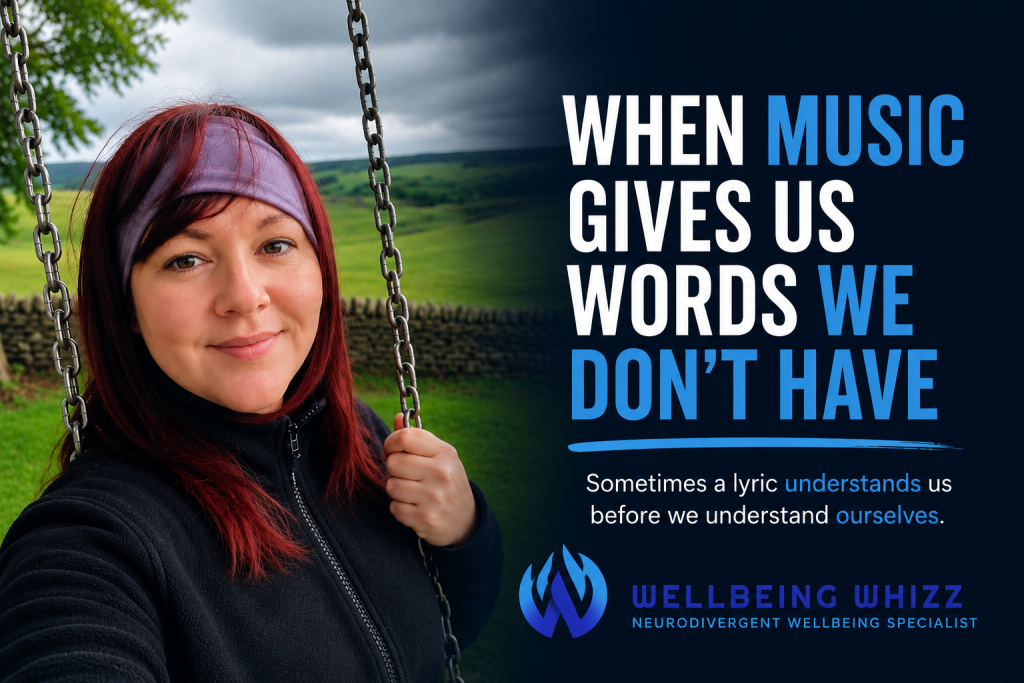
Sitting on a swing during a retreat this weekend, I found myself reflecting on the concept of connection, and specifically, how music and songs can foster a deep connection to a person, a place, or a memory. I also thought about how music can highlight disconnection or help us bridge a gap when words fail us entirely.
In the wellbeing space, we often talk about emotions as if they always arrive neatly packaged in language: “I feel sad,” “I feel anxious,” or “I feel hopeful.” But for many autistic people, individuals who experience alexithymia (difficulty identifying and describing emotions), or honestly, anyone going through a period of high cognitive load, it doesn’t always work that way. The feeling is entirely real and present in the body, but the words to label it simply aren’t there.
That is where music becomes a bridge.
Music as an Emotional Translator
Sometimes we hear a song and think, “That’s it. That’s the exact feeling.” It’s not necessarily because the lyrics literally describe our current life setup, but because the melody, the tone, or a specific phrase captures an emotional landscape we couldn’t quite put into language ourselves.
Music allows us to experience, process, and sit with emotions without requiring us to name them first. It creates a safe channel for connection in several ways:
- Connection to ourselves through allowing an internal feeling to be mirrored externally.
- Connection to a time or place by instantly transporting us back to a specific version of who we were.
- Connection to others through feeling seen by a stranger who wrote a lyric that perfectly understands our internal world.
Conversely, music can also safely highlight disconnection. Sometimes a song helps us recognise a hidden grief, realise how much we’ve changed, or gives us permission to release an emotion we’ve been subconsciously avoiding. We might find ourselves crying because of the song itself, rather than the situation we are actually facing. The music simply gives us a safe space to let it out.
Whilst reflecting this weekend, I found myself listening to Learn to Fly by the Foo Fighters. One lyric in particular stood out:
“Looking around for a complication.”
It made me pause because I realised that, for much of my life, I’ve often expected things to be difficult. If something is going well, part of me starts looking for the catch, the obstacle, or the complication I must have missed.
I think what drew my attention to this was that perhaps the first time in a long while, I wasn’t scanning for complications. I was simply present.
I hadn’t consciously identified that shift until I heard the lyric. The song gave me words for something I was experiencing but hadn’t fully articulated to myself yet.
That, to me, is one of the most powerful things music can do. It doesn’t just help us express emotions we already understand. Sometimes it helps us discover emotions, beliefs, or patterns that were influencing us long before we became consciously aware of them.
The Playlist as Data
In my client work, I frequently see how powerful this is. When many people find it difficult or overwhelming to answer standard check-in questions like, “How have you been feeling this week?” they can almost always answer this one “What song or playlist have you had on repeat?”
Suddenly, the playlist becomes data. It isn’t definitive proof of a specific psychological state, but it is a vital clue and a gentle starting point for curiosity. When we notice what we are repeatedly listening to, we can start asking ourselves:
- What is it about this specific sound or tempo that resonates right now?
- Which lyrics are standing out to me?
- What physical feeling or shift does this music create in my body?
For those who find identifying emotions tricky, a weekly soundtrack often tells a much truer story than spoken words can. Of course, it is also important to acknowledge that we don’t always loop a track because of a deep emotional connection. Sometimes, it is purely about sensory seeking.
For many neurodivergent brains, repeating a specific song, a particular 10-second baseline, or a distinct vocal harmony is a form of auditory stimming. We aren’t necessarily trying to process a hidden grief or a complex feeling; we are returning to it because it literally just feels nice in our bodies. It scratches a specific sensory itch, helps us focus, or provides a quick splash of much-needed dopamine.
Whether your repeat track is translating an unspoken feeling or acting as a predictable sensory comfort, a weekly soundtrack often tells a much truer story about our current regulation needs than spoken words can.
A Quick Reflection: The Soundtrack of Your Week
If you want to explore this in your own life this week, take a moment to look at your recently played tracks and ask yourself these low-demand questions:
- What song or genre are you gravitating toward right now?
- What might this music be helping you connect with?
- Is there something it is helping you safely process or let go of?
Connection doesn’t always have to be built through conversation. Sometimes, it’s built through a melody, a memory, or a lyric that somehow understands us before we’ve even figured out how to understand ourselves.